
Vertical Space: Why Cats Need to Climb
How height and vertical spaces help cats feel secure and content in their environment.
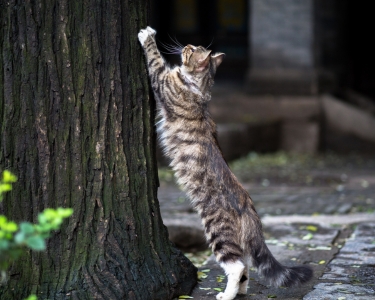
Most homes with a cat have a few tell-tale signs of a climber. There are paw prints on top of the fridge, a face peering down from a bookshelf and a warm patch on the wardrobe. The liking for height goes back a long way. Wild ancestors of the domestic cat climbed trees to stay out of reach, keep watch over their patch and drop on unsuspecting prey. Your cat has no such worries, but the pull towards high ground has stayed with them.
The Security of Heights
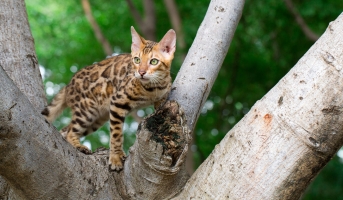
A startled cat usually heads for the highest point in the room, and there's good sense behind it. From up there, they can see the whole room without worrying about what might come at them from behind or above. That clear view lets them settle, since any approaching danger, including the vacuum cleaner, is spotted well in advance.
Researchers in Brazil tested this with 35 cats living together in a rescue shelter. They fixed boxes to the walls at floor level, at half a metre and at a metre, then watched which ones the cats used. Cats hopped into the boxes on the floor more often, but the ones who climbed to the box at half a metre stayed there for far longer. The boxes at a metre were never used at all.
The researchers suggested the highest box asked too much of the cats, since there was nothing between the floor and the box to break up the jump. It's a small study in one shelter, so it's a hint rather than a rule, and it does suggest that a route up matters as much as the perch itself.
For a timid or anxious cat, a high spot is especially valuable. And cats assess their territory in three dimensions, which changes what a home looks like to them...
Download and sign up to the My Feline app to read the full article...
Research rating: ⭐⭐ (2 of 5). Last updated 25 August 2026.
Sources
- Adriana Sicuto de Oliveira, César Augusto Sangaletti Terçariol, and Gelson Genaro. The Use of Refuges by Communally Housed Cats. https://doi.org/10.3390/ani5020245
- Emma J. Desforges, Alexandra Moesta and Mark J. Farnworth. Effect of a shelf-furnished screen on space utilisation and social behaviour of indoor group-housed cats (Felis silvestris catus). https://doi.org/10.1016/j.applanim.2016.03.006.
- Sarah L.H. Ellis, Ilona Rodan, Hazel C. Carney, Sarah Heath, Irene Rochlitz, Lorinda D. Shearburn, Eliza Sundahl and Jodi L. Westropp. AAFP and ISFM Feline Environmental Needs Guidelines. https://doi.org/10.1177/1098612X13477537