
The Science of Cat Grooming
How cats groom themselves and when they might need our help - understanding the balance between natural and assisted care.
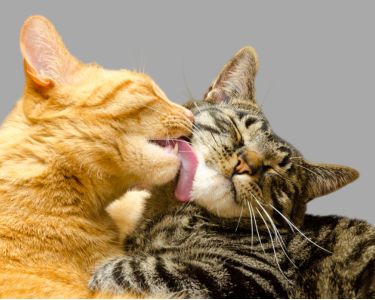
A cat can spend up to a quarter of its waking hours washing. That works out at a couple of hours a day, which is a lot of effort for an animal that also needs to sleep for fourteen. Grooming does more than keep the coat tidy. It cools the body, keeps pests down and seems to steady a cat's mood. Most cats manage it well on their own. Knowing how they do it makes it easier to spot the moments when a little help is welcome.
The Cat's Grooming Tools
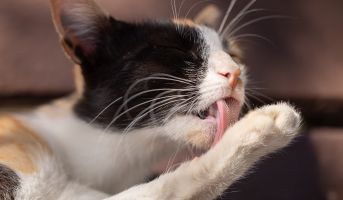
A cat's tongue feels like sandpaper because it is covered in hundreds of backward-facing spines called papillae. For decades these were thought to be solid cones. In 2018, engineers at Georgia Tech used high-speed film and CT scans to look properly. Each spine turned out to be hollow at the tip, with a scoop-shaped cavity that works like a tiny ladle.
When a cat licks, the spines stand upright and push down into the fur. The hollow tips draw saliva up from the mouth by surface tension, in the same way a paper towel soaks up a spill. A domestic cat has about 290 of these spines on the working part of its tongue. Between them they hold around a tenth of an eyedropper drop. That sounds like nothing, but the spines carry it right down to the skin, where the flat surface of the tongue could never reach.
Each lick leaves nearly half the saliva on the tongue behind in the fur, and that saliva does several jobs at once. It loosens dead hair and dirt, spreads the skin's natural oils along the coat, dislodges fleas before they settle in and cools the skin as it evaporates.
That cooling turns out to matter more than most people realise...
Download and sign up to the My Feline app to read the full article...
Research rating: ⭐⭐⭐ (3 of 5). Last updated 25 August 2026.
Sources
- Alexis C. Noel and David L. Hu. Cats use hollow papillae to wick saliva into fur. https://doi.org/10.1073/pnas.1809544115
- Elena T. Contreras, Raphael Vanderstichel, Claire Hovenga, Michael R. Lappin. Evaluation of hair and nail cortisol concentrations and associations with behavioral, physical, and environmental indicators of chronic stress in cats. https://doi.org/10.1111/jvim.16283