
The Power of Whiskers
How cats use their whiskers to measure spaces and navigate their environment

Whiskers tell a cat where things are, how big a gap is and what a surface feels like, and they do it in the dark too. A good deal of engineering has gone into how such a simple-looking hair manages all that.
What Whiskers Are Made Of
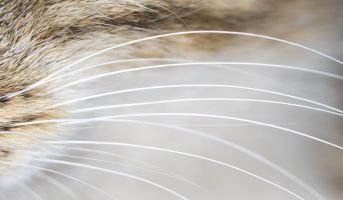
Whiskers are known as vibrissae. Each one sits in a deep follicle packed with blood vessels and nerve endings. That makes it sensitive to the lightest touch and even to a change in the air. A cat has around 24 on its face, twelve each side in four rows across the cheeks. There are a few more above the eyes, on the chin and on the backs of the front legs.
A team from Manchester Metropolitan University and London South Bank University measured whiskers from nineteen kinds of mammal, including cats. They found the same design everywhere. Every whisker is a tapered, curved rod, thick at the base and fine at the tip. The curve follows a mathematical shape called an Euler spiral. The thick base gives the whisker stability. The fine tip bends at the slightest contact.
When a whisker touches something, it bends, and the bend presses on the nerves in the follicle. The signal that reaches the brain carries information about where the object is, how big it is and what it is made of.
One popular idea is that a cat's whiskers stretch roughly as wide as its body, making them a built-in measure of whether it will fit through a gap. It is a tidy explanation and it is repeated everywhere. What the research actually shows about how a cat checks a gap is a little different...
Download and sign up to the My Feline app to read the full article...
Research rating: ⭐⭐⭐ (3 of 5). Last updated 25 August 2026.
Sources
- George E. Carvell and Daniel J. Simons. Effect of whisker geometry on contact force produced by vibrissae moving at different velocities. https://doi.org/10.1152/jn.00046.2017
- Gary Dougill, Eugene L. Starostin, Alyx O. Milne, Gert H. M. van der Heijden, Victor G. A. Goss, and Robyn A. Grant. Ecomorphology reveals Euler spiral of mammalian whiskers. https://doi.org/10.1002/jmor.21246
- Christopher M. Williams and Eric M. Kramer. The Advantages of a Tapered Whisker. https://doi.org/10.1371/journal.pone.0008806