
Social Lives of Cats: More Complex Than We Thought
How cats interact with other cats and what this tells us about their social needs
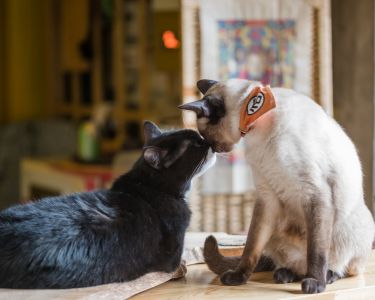
For years, cats were thought to be solitary creatures who tolerated other animals. Research shows they lead complex social lives. They form bonds, recognise emotions, and adjust their behaviour to suit the social moment. That aloof, independent cat of yours might well be a social butterfly.
The Social Cat: Not So Solitary After All

Cats have a reputation as loners, but they are social. Unlike their wild ancestors, domestic cats have learned to live alongside both humans and other cats.
When cats live in groups, they develop preferences for certain companions. They share jobs like caring for kittens, they keep friendships that can last for years, and they have their own social circles.
When cats meet, they communicate through subtle body language. We tend to watch the tail, but the position of the ears matters too. Two cats meeting with upright ears are usually having a friendly encounter, and it might lead to a gentle head bump or a relaxed lounge together. If one cat's ears are flattened back, something might be afoot.
This communication helps cats avoid needless conflict. Physical fights are rare, and most disagreements are settled through body language instead. Cats can also recognise emotions in other cats and in us...
Download and sign up to the My Feline app to read the full article...
Research rating: ⭐⭐⭐⭐ (4 of 5). Last updated 25 August 2026.
Sources
- Quaranta A, d'Ingeo S, Amoruso R and Siniscalchi M. Emotion Recognition in Cats. https://doi.org/10.3390/ani10071107
- Finka LR. Conspecific and Human Sociality in the Domestic Cat: Consideration of Proximate Mechanisms, Human Selection and Implications for Cat Welfare. https://doi.org/10.3390/ani12030298
- Turner DC. The Mechanics of Social Interactions Between Cats and Their Owners. https://doi.org/10.3389/fvets.2021.650143
- Gajdoš Kmecová N, Peťková B, Kottferová J, Skurková L and Mills DS. Are These Cats Playing? A Closer Look at Social Play in Cats and Proposal for a Psychobiological Approach and Standard Terminology. https://doi.org/10.3389/fvets.2021.712310
- Vitale KR. The Social Lives of Free-Ranging Cats. https://doi.org/10.3390/ani12010126