
Noise Sensitivity: Understanding Your Cat's Startle Response
Fireworks send many cats straight under the bed. Here's what owner surveys and two small studies show about the startle, and the simple comforts that seem to help.
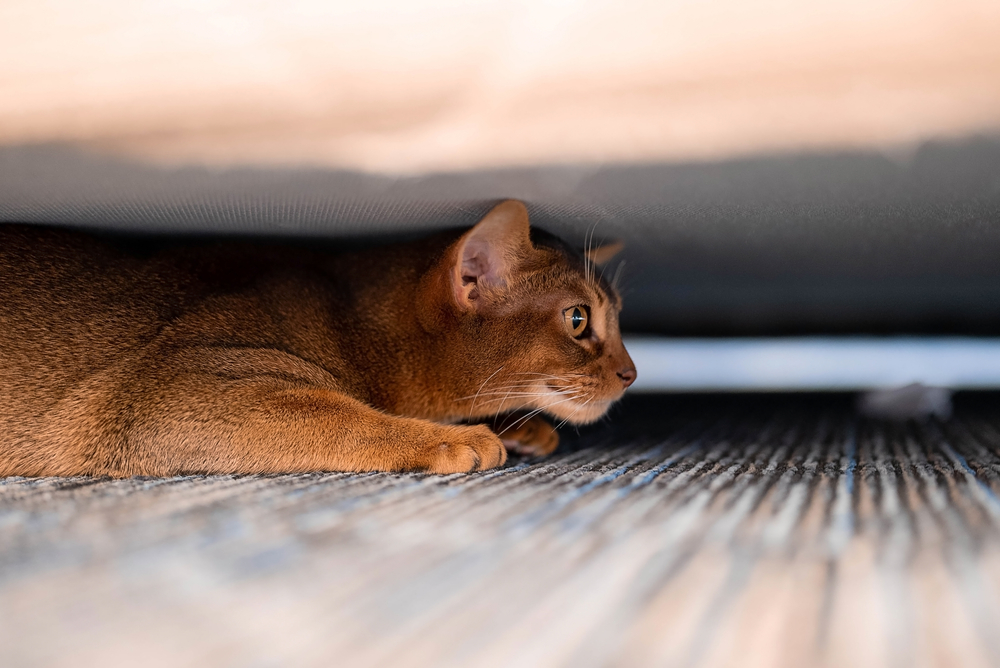
A firework goes off outside, and your cat is under the bed before the sound has faded. That jump is called a startle, and it's one of the most ordinary things a cat's body does.
In the UK, fireworks are common from Bonfire Night through to New Year's Eve, so many cats have several noisy weeks each year. Researchers have asked hundreds of owners how their cats react to fireworks. They have also measured the startle itself in the laboratory. The findings are largely reassuring, since most of what cats do when the bangs begin is a sensible way of coping. A few simple comforts at home also seem to help.
Why a Hiding Place Helps
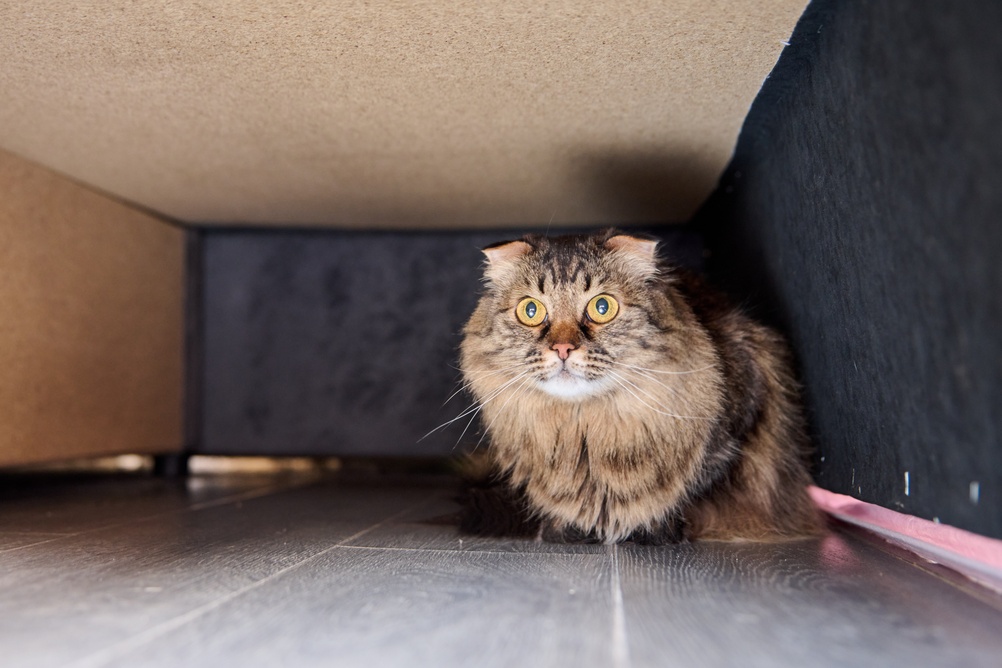
Hiding is the reaction owners reported most, and a Dutch study from 2019 shows how much a hiding place can matter to a stressed cat. The study was small, and the researchers followed 23 cats during their first 12 days in an animal shelter. About half of the cats were given a cardboard box with two entrances. The others had no box.
Each cat's stress was scored from its posture and behaviour. All of the cats relaxed as the days passed. The cats with a box settled about a week sooner than the cats without one. With so few cats involved, the result is best read as an early sign.
A shelter is a different kind of stress from a night of fireworks, though the finding fits with what owners do at home. More than half of the Dutch cat owners said they gave their cat somewhere to hide during fireworks...
My Feline doesn't endorse research that causes stress, negative experiences or harm to living cats. The startle reflex study listed in the sources is included only because the research has already been carried out.
Download and sign up to the My Feline app to read the full article...
Research rating: ⭐⭐ (2 of 5). Last updated 16 November 2026.
Sources
- Dale AR, Walker JK, Farnworth MJ, Morrissey SV, Waran NK. A survey of owners' perceptions of fear of fireworks in a sample of dogs and cats in New Zealand. https://doi.org/10.1080/00480169.2010.69403
- van Herwijnen IR, Vinke CM, Arndt SS, Roulaux PEM. Firework aversion in cats and dogs as reported by Dutch animal owners. https://doi.org/10.1016/j.vas.2024.100402
- Hague DW, Stella JL, Buffington CAT. Effects of interstitial cystitis on the acoustic startle reflex in cats. https://doi.org/10.2460/ajvr.74.1.144
- van der Leij WJR, Selman LDAM, Vernooij JCM, Vinke CM. The effect of a hiding box on stress levels and body weight in Dutch shelter cats; a randomized controlled trial. https://doi.org/10.1371/journal.pone.0223492