Making Muffins: The Science of Kneading
Your cat pushes one paw after the other into your lap and purrs. Nobody has studied why. Here's what the research gets close to, and where the mystery still stands.
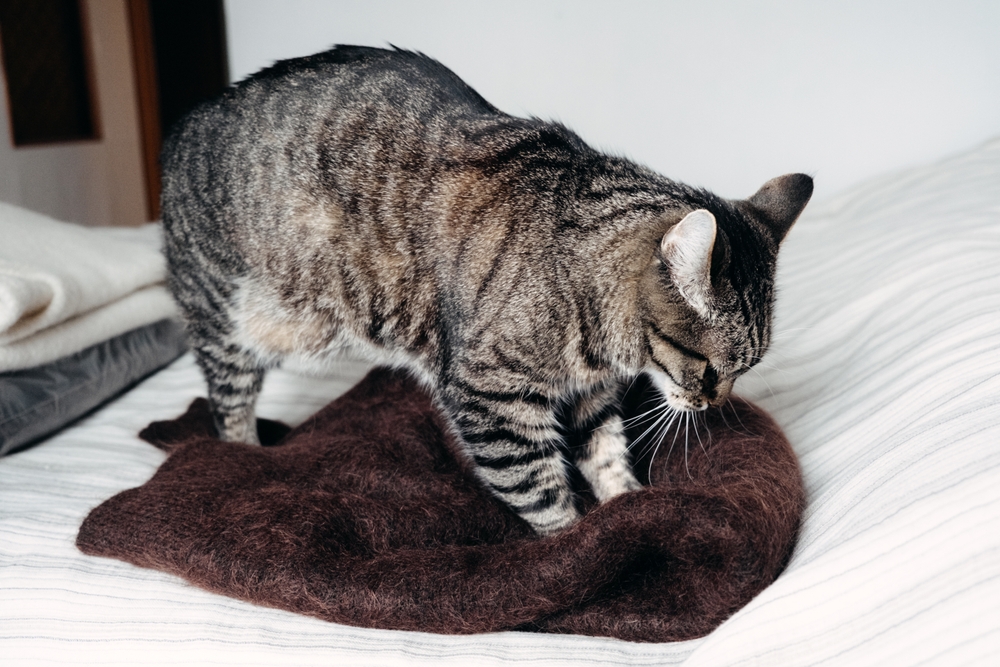
Your cat climbs onto your lap, turns a circle or two and starts to push. One front paw presses down, then the other, with a dreamy look and often a purr to go with it. Cat people call it making muffins, making biscuits or kneading dough. If you own a blanket with little holes in it, you know the feeling.
For something cats do so often, kneading has had hardly any attention from researchers. Scientists have noticed it, written it down and put it on their lists of what a settled cat does. We found no study that set out to ask why cats do it. That leaves plenty of room for guessing, which is part of the fun.
Where the muffins begin
Kittens begin kneading in their first days of life. They push their front paws against their mother's belly as they feed, and the usual explanation is that this helps the milk flow. Many people think adult kneading is a leftover from those feeds, and that's a sensible guess. Kittens knead while they feed, grown cats knead while they're comfortable and the two look alike. Even so, the link between them hasn't been put to the test, as far as we can find.
If your cat has ever gone glassy-eyed on your cardigan sleeve, you're in good company. In a Finnish survey of 5,726 cats across 40 breeds, nearly a third had sucked or chewed wool at least once in their lives. The Helsinki researchers note that wool sucking is thought to come from the urge to suckle. That is a feeding habit a kitten would normally aim at its mother. Cats that had stayed with their mother into adulthood were the least likely to suck wool. Cats that left her earlier were more likely to do it. So the urge to suckle doesn't switch off on its own, and it can follow a cat for life when feeding ends before the cat is ready.
Wool sucking is a different habit from kneading, and the Finnish study doesn't mention kneading at all. It does show that a piece of kittenhood can last a lifetime, which is the idea behind the muffin theory.
What a kneading cat is feeling
When vets want to know whether a cat is happy, kneading is on their checklist. In 2021, researchers at University College Dublin built a guide to help vets and nurses read a cat's mood in the consulting room. They read what had already been written about cat body language and asked two cat behaviour experts to check their work. The guide sorts behaviour into five moods, and kneading or treading with the paws appears only under Contentment. It sits in the same box as stretching, yawning, grooming and head butting. A contented cat, the guide says, has small pupils (the dark centres of the eyes), ears pointing forward and a relaxed, still tail.
That backs up what many owners already suspect. The muffins mean your cat is comfortable. Cats can feel two things at once, and the guide's authors often saw mixed moods. A kneading cat with ears pressed back or wide pupils may be comfortable and uneasy at the same time. The whole cat tells you more than the paws do.
The kitten switch
In 2008, researchers at The Ohio State University tested a way of keeping cats still for examinations and noticed something odd. They placed ordinary binder clips, the kind from a stationery drawer, on the loose skin at the back of the neck. That is the spot a mother cat uses to pick up her kittens. All but one of the 31 cats went quiet and still. Most of them, the researchers report, purred and kneaded with their paws while the clips were on. The response looked to them like the stillness of a kitten being carried, and they suggested that adult cats keep it from kittenhood. The cats showed no physical signs of stress, so the Ohio team concluded they weren't frightened or in pain.
Kneading is still a sign of a comfortable cat. The interesting part of this study is what set it off. A clip on the scruff is nothing like a warm lap, yet it brought out the same purring and kneading a cat shows when it's settled. That suggests kneading is wired into cats from their earliest days, when being held by the scruff meant being carried by their mother, and the right touch can switch it on.
One caution on the clips themselves. In 2020, researchers at the University of Guelph tried similar clips and found that the same cats showed more signs of stress with the clips on than when they were gently held, so they recommended against using them. For our story, that only makes the kneading odder. If the clips weren't pleasant, then the Ohio cats kneaded through something they didn't enjoy, which shows how deep the reflex seems to run. Neither study claims this itself, so it's our reading of the two together. It fits what happens on the sofa, though.
The paw-print theory
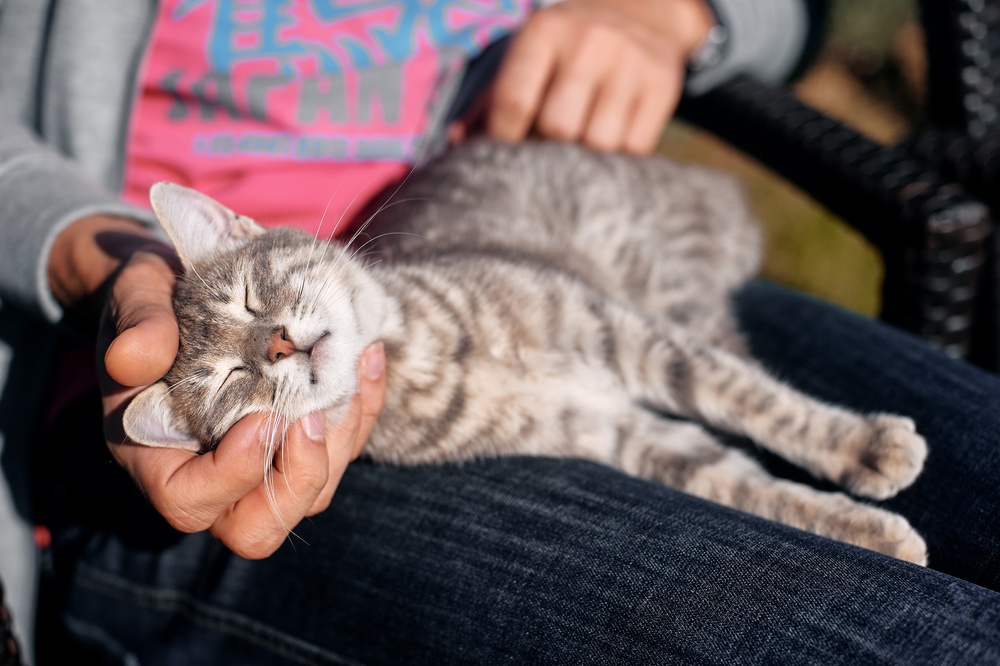
One more idea is a long way from proven but fun to think about. Your cat may be leaving a scent on you as they knead. Cats do sweat, just through their feet. A 2022 review by researchers at South China Agricultural University notes that cats have sweat glands in their paw pads and between their toes. The smell these glands give off, the review says, may play a part in scent marking. The review raises this while discussing scratching, where a cat drags its claws down a surface and leaves a mark and a smell behind. Whether kneading leaves a scent too is anyone's guess. It would make for an interesting study.
The same review mentions the scent of a nursing mother. The skin around a mother cat's teats gives off a scent that may calm both her and her kittens. A man-made copy of it is sold as a calming spray for cats. If that's right, the first place a kitten ever kneads is also a place that smells of safety. We don't know yet if the smell of your lap does anything similar for your cat. It's a nice thought.
The theories with no study behind them
A few other ideas do the rounds, and we found no research on any of them.
🌾 Kneading is a leftover from wild ancestors trampling grass into a bed, since cats often knead before settling down.
🧘 It stretches the muscles of the front legs and shoulders after a sleep.
💕 Female cats that haven't been spayed knead more when they're ready to mate.
They all sound reasonable, which is probably why they get repeated so often. We'd love to see someone test them.
Living with a muffin maker
A cat who kneads on you has picked you as a place they feel at ease. A folded blanket on your lap gives the claws something to sink into other than your legs. If the claws are out, a trim takes the ouch out of it. Some cats drool while they knead, which goes with the dreamy look and is nothing to worry about. Others suck on a blanket or a sleeve as they go, which may be another leftover from feeding time. If the sucking turns into chewing and swallowing fabric, that's worth a word with your vet.
Not every cat kneads, and a cat who doesn't is no less fond of you. Plenty of settled, affectionate cats go through life without making a single muffin.
Key takeaways
🧁 Cats knead all the time, yet we found no research that has tested why they do it.
🍼 It may be leftover nursing behaviour, though that hasn't been tested. A big Finnish survey shows that another feeding habit called wool sucking does carry into adulthood. Cats that stayed with their mother longest were the least likely to do it, and cats that left her earlier were more likely to.
😌 A 2021 vets' guide to cat moods lists kneading under Contentment, alongside stretching, yawning and head butting.
🐾 In one study, cats purred and kneaded when clips were put on the loose skin of the neck, where a mother picks up her kittens. Kneading looks like a reflex from kittenhood that the right touch can switch on, even without a warm lap.
👃 Cats have glands in their paws whose scent may play a part in marking. Whether kneading leaves a scent on you hasn't been tested.
💛 Kneading is harmless, and a blanket on your lap keeps claws and legs apart. Not every cat kneads, and that says nothing about how fond of you they are.
Research rating: ⭐⭐ (2 of 5). Last updated 13 November 2026.
Sources
- Nicholson SL, O'Carroll RÁ. Development of an ethogram/guide for identifying feline emotions: a new approach to feline interactions and welfare assessment in practice. https://doi.org/10.1186/s13620-021-00189-z
- Pozza ME, Stella JL, Chappuis-Gagnon AC, Wagner SO, Buffington CAT. Pinch-induced behavioral inhibition ('clipnosis') in domestic cats. https://doi.org/10.1016/j.jfms.2007.10.008
- Ahola MK, Vapalahti K, Lohi H. Early weaning increases aggression and stereotypic behaviour in cats. https://doi.org/10.1038/s41598-017-11173-5
- Zhang L, Bian Z, Liu Q, Deng B. Dealing With Stress in Cats: What Is New About the Olfactory Strategy? https://doi.org/10.3389/fvets.2022.928943
- Moody CM, Mason GJ, Dewey CE, Niel L. Getting a grip: cats respond negatively to scruffing and clips. https://doi.org/10.1136/vr.105261