
Cat Hearing: Tuned for Hunting
How cats use their exceptional hearing abilities and what sounds matter most to them in their daily lives.
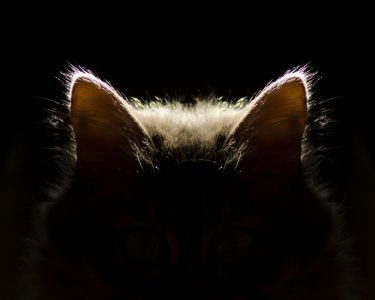
Your cat's ears do more than swivel when the treat jar opens. They are built for hunting, and millions of years of evolution have tuned them to the sounds small prey make. Your cat may spend most of the day asleep, but their hearing is still that of a working predator.
Knowing how your cat hears explains a lot of everyday behaviour, from sudden alertness in a silent room to knowing exactly where the toy mouse landed under the sofa.
How a Cat's Ears Work

Each ear moves on its own, so your cat can follow two sounds at once. More than thirty small muscles turn each ear through almost a half circle, which lets your cat listen behind them while looking straight ahead.
The outer ear, the triangular part you can see, works like a funnel and sends sound down a canal that is deeper and more sharply angled than ours. Three tiny bones in the middle ear pass the vibrations along, and the inner ear turns them into signals the brain can read. When there are several sounds in a room, you may see one ear pointing at the television while the other follows footsteps in the hall.
People hear sounds between about twenty and twenty thousand hertz, the unit for how high or low a sound is. Cats hear up to around eighty-five thousand hertz, more than four times our upper limit. That extra range covers the very high squeaks mice and other small animals use to talk to each other, which are silent to us.
So when you call your cat from across the room and they look straight at you, how do they know...
Download and sign up to the My Feline app to read the full article...
Research rating: ⭐⭐⭐ (3 of 5). Last updated 25 August 2026.
Sources
- Heffner RS, Heffner HE. Hearing range of the domestic cat. https://doi.org/10.1016/0378-5955(85)90100-5
- Tollin DJ, Ruhland JL, Yin TCT. The role of spectral composition of sounds on the localization of sound sources by cats. https://doi.org/10.1152/jn.00358.2012